

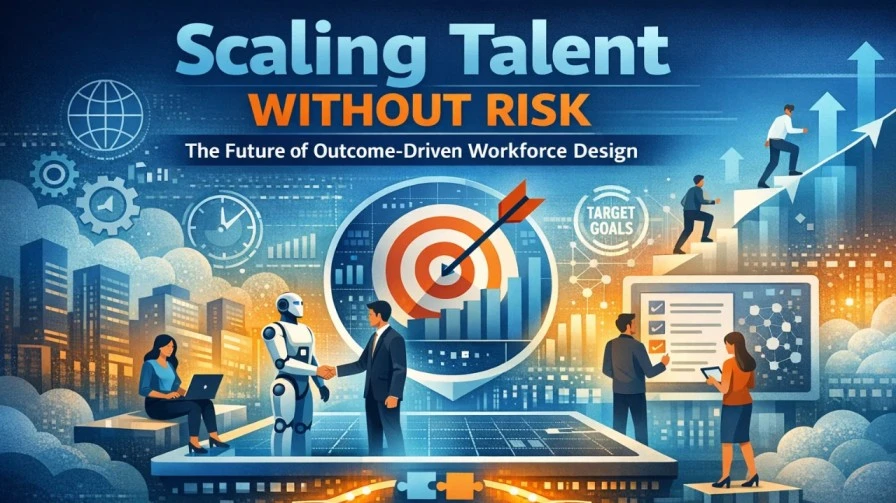
Scaling Talent Without Risk: The Future of Outcome-Driven Workforce Design
In a world defined by volatility, regulation, and rapid digital change, organizations are being forced to rethink how they build and manage talent. Traditional, headcount-heavy workforce models—rigid, slow, and risk-prone—are no longer fit for purpose.
The future belongs to compliant, outcome-driven workforce models—structures that prioritize measurable business outcomes, regulatory alignment, and scalability without sacrificing agility.
At Meraqui, we see this shift not as a trend, but as a strategic imperative.
The Problem with Traditional Workforce Models
For decades, companies have scaled by adding people. More demand meant more hiring. While this approach worked in stable environments, it now exposes organizations to multiple challenges:
Compliance risk across labor laws, gig regulations, and cross-border hiring
High fixed costs with limited flexibility
Misaligned incentives, where effort is rewarded over outcomes
Slow scalability, especially during demand spikes or market downturns
In regulated markets like India—and increasingly across the globe—these risks are no longer manageable side effects. They are board-level concerns.
What Does “Outcome-Driven” Really Mean?
An outcome-driven workforce model shifts the focus from who is doing the work to what value is being delivered.
Instead of measuring success by hours logged or roles filled, organizations define:
Clear deliverables and performance metrics
Time-bound outcomes tied to business goals
Accountability at the system level, not just the individual level
This approach enables leaders to scale operations while maintaining clarity, control, and consistency.
Why Compliance Must Be Designed In—Not Added Later
Compliance is often treated as a checkbox—something addressed after contracts are signed and teams are deployed. This is a costly mistake.
True scalability requires compliance by design:
Workforce structures aligned with labor codes and statutory requirements
Clear distinction between employees, contractors, and partners
Transparent documentation, audits, and governance frameworks
Risk mitigation across co-employment and misclassification
When compliance is embedded into the workforce model itself, organizations gain confidence to scale—across geographies, business lines, and demand cycles.
The Meraqui Approach: Workforce as a Strategic System
At Meraqui, we help enterprises move beyond transactional staffing toward integrated workforce systems.
Our approach is built on three core pillars:
1. Outcome-Aligned Design:
We co-create workforce models that map directly to business outcomes—whether it’s sales productivity, operational efficiency, or customer experience.
2. Compliance-First Architecture
From statutory adherence to evolving gig and contract labor regulations, compliance is embedded into every layer of the model.
3. Scalable Execution
Through standardized processes, digital oversight, and performance governance, organizations can scale up or down without operational friction.
The result: faster execution, lower risk, and measurable ROI.
Why This Matters Now
The rise of hybrid work, gig talent, and distributed teams has blurred traditional employment boundaries. Regulators are catching up—and enforcement is increasing.
Organizations that proactively adopt compliant, outcome-driven workforce models will:
Scale faster than competitors
Reduce legal and operational risk
Improve productivity and accountability
Build resilient talent ecosystems for the future
Those that don’t will find themselves constrained by outdated structures and growing compliance exposure.
The Road Ahead
The question is no longer whether workforce models need to change, but how quickly organizations can adapt.
Building at scale today requires more than hiring—it requires intentional design.
At Meraqui, we believe the most successful enterprises will be those that treat workforce strategy as a core business capability—one that is compliant, outcome-driven, and built to evolve.
The future of work isn’t about more people.
It’s about better outcomes—delivered responsibly, at scale.

Leave a Reply